


Back to top
Antisense Oligos for Screening Applications

Microsynth provides high-quality antisense oligonucleotide (ASO) synthesis, designed for screening and early-stage ASO development. Our portfolio includes a broad range of backbone and sugar modifications to optimize stability, affinity and activity.
ASOs can modulate RNA function through different mechanisms, including RNase H-mediated knockdown (gapmers), splice modulation (e.g. exon skipping), and steric blocking approaches.
For preclinical ASO programs including low endotoxin production, please refer to our therapeutics page.
Applications
- Antisense screening
- mRNA knockdown studies
- Target validation
- Early-stage oligonucleotide research
Why choose Microsynth ASOs?
- High-quality ASOs with MALDI-TOF MS control
- Broad portfolio of antisense modifications
- Flexible backbone and chemistry design
- Fast production timelines
- Expert technical support
- Easy online ordering and re-ordering
Order your custom antisense oligonucleotides now or contact our experts to discuss your ASO design and modification strategy.
Available ASO Modifications
Microsynth offers a comprehensive set of antisense chemistries for screening applications. These chemistries are widely used in modified antisense oligonucleotides to improve stability, affinity and biological activity.
Standard and advanced modifications
- 2'-O-Methyl (2'-OMe)
- 2'-Fluoro (2'-F)
- MOE (2'-methoxyethyl)
- LNA
- S-cEt (on request)
Backbone chemistries
- Phosphorothioate (PTO)
- Mesyl (µ) bonds
- Phosphoryl guanidine (PN) bonds
Structural designs
- Gapmers
- GalNAc conjugates
The full list can be found here. View modification details (expand)
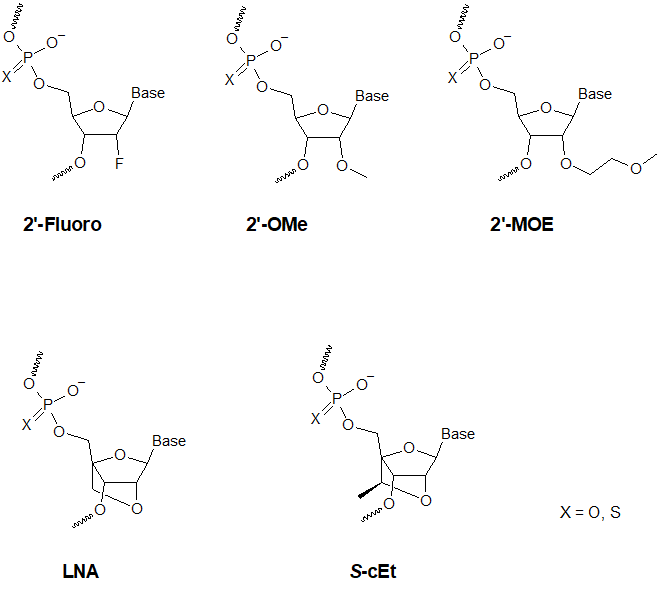
-
PTO (phosphorothioates) modifications: PTOs contain one sulfur atom in place of an oxygen atom in the internucleotide linkage of DNA or RNA. This modification of the normal phosphodiester backbone is characterized by an increased cell uptake, high nuclease resistance and elicitation of RNase H activity.
- 2'-O-Me-RNA modifications: The incorporation of 2'-O-Methyl RNA nucleotides induces a resistance to a wide variety of nucleases, in particular, RNase. Furthermore, 2’-OMe oligonucleotides show a slightly increased affinity towards their complementary mRNA target sequence, thereby forming more stable hybrid duplexes compared to their non-modified DNA or RNA counterparts. This enables the formation of more stable hybrids with complementary RNA strands than would be the case for non-modified DNA and RNA sequences.
-
2'-MOE-RNA modifications: Oligonucleotides incorporating 2'-O-methoxyethyl (MOE)-modified nucleotides, can support most, if not all antisense mechanisms of action. Further key distinctive characteristics are nuclease resistance, lower toxicity, superior target binding specificity, as well as an increased affinity towards complementary RNA. For more detailed information about 2'-MOE antisense oligonucleotides from Microsynth, please refer to the flyer on the right-hand side.
-
LNA modifications: LNA containing oligonucleotides offer substantially increased affinity for its complementary strand, compared to traditional DNA or RNA oligonucleotides. This and the concomitant high nuclease resistance of LNAs results in unprecedented sensitivity and specificity and makes LNA™ oligonucleotides ideal for use in antisense applications.
- S-cEt modifications: S-cEt oligonucleotides (constrained ethyl nucleotides) are an advancement of LNA oligonucleotides. They have been developed for antisense applications and are mainly used in gapmers. Such ASOs show superior stability towards nuclease degradation compared to LNA without compromising binding selectivity or hybridization stability.
- N-acetylgalactosamine (GalNAc): Conjugation of N-acetylgalactosamine (GalNAc) has become a major clinical strategy for the delivery of oligonucleotides to hepatocytes (liver cells). Such conjugates are efficiently internalized by binding to the asialoglycoprotein receptor (ASGPR), which exhibits high affinity for N-acetyl galactosamine terminated oligosaccharides.
To learn more about the specifications of these five types of modifications, please see the table below.
Key Specifications:
|
Modifications |
Position |
Synthesis scale [µmol] | Purification1 | |||||
|
5’ |
3’ |
Int. |
0.04 |
0.2 |
1 |
15 |
HPLC + Dialysis |
|
|
PTO |
x |
x |
x |
x |
x |
x |
||
| 2’-O-Me-RNA |
x |
x |
x |
x |
x |
x |
x |
x |
| 2'-MOE-RNA | x | x | x | x | x | x | x | x |
| LNA | x | x | x | x | x | x | x | x |
| GalNAc | x | x | x | x | x | |||
1 We strongly recommend to order ASOs with “HPLC + Dialysis” purification. The Na+ salt exchange is necessary to remove toxic salts from HPLC purification. For in vivo testing we recommend our low endotoxin oligonucleotides.
Design Flexibility
With PTO, µ (Mesyl), and PN backbone chemistries, ASO design can be fine-tuned to balance:
- Stability
- Activity
- Cellular uptake
- Toxicity profile
Our experts support you in selecting the optimal modification strategy for your screening application.
Synthesis Scales & Purification
Expand for details on synthesis scales and purification.
Notes
- Synthesis scale refers to the initial amount of 3′ bases used during synthesis
- Guaranteed yields are given in OD260 and calculated for a 20-mer oligonucleotide
Desalted
| Synthesis scale1 | Length Restriction | Guaranteed Yield2 | Production Time [wd] | |
| [OD260] | [nmol]3 | |||
| 0.04 µmol | 13 - 30 | 3 | 15 | 2-3 |
| 0.2 µmol | 10 | 50 | 2-3 | |
| 1.0 µmol | 30 | 150 | 2-3 | |
| 15 µmol | 600 | 3'000 | 3-5 | |
HPLC
| Synthesis scale1 | Length Restriction | Guaranteed Yield2 | Production Time [wd] | |
| [OD260] | [nmol]3 | |||
| 0.04 µmol | 13 - 30 | 1 | 5 | 3-4 |
| 0.2 µmol | 3 | 15 | 3-4 | |
| 1.0 µmol | 10 | 50 | 3-4 | |
| 15 µmol | 300 | 1'500 | 4-6 | |
HPLC & Dialysis
| Synthesis scale1 | Length Restriction | Guaranteed Yield2 | Production Time [wd] | |
| [OD260] | [nmol]3 | |||
| 0.04 µmol | 13 - 30 | - | - | - |
| 0.2 µmol | 3 | 15 | 3-5 | |
| 1.0 µmol | 10 | 50 | 3-5 | |
| 15 µmol | 250 | 1'250 | 5-7 | |
PAGE
| Synthesis scale1 | Length Restriction | Guaranteed Yield2 | Production Time [wd] | |
| [OD260] | [nmol]3 | |||
| 0.04 µmol | 13 - 30 | 0.5 | 2.5 | 3-4 |
| 0.2 µmol | 2 | 10 | 3-4 | |
| 1.0 µmol | 7 | 35 | 3-4 | |
| 15 µmol | - | - | - | |
HPLC
| Synthesis scale1 | Length Restriction | Guaranteed Yield2 | Production Time [wd] | |
| [OD260] | [nmol]3 | |||
| 0.04 µmol | 13 - 30 | 1 | 5 | 3-4 |
| 0.2 µmol | 3 | 15 | 3-4 | |
| 1.0 µmol | 8 | 40 | 3-4 | |
| 15 µmol | 300 | 1'500 | 4-6 | |
HPLC & Dialysis
| Synthesis scale1 | Length Restriction | Guaranteed Yield2 | Production Time [wd] | |
| [OD260] | [nmol]3 | |||
| 0.04 µmol | 13 - 30 | - | - | - |
| 0.2 µmol | 3 | 15 | 3-5 | |
| 1.0 µmol | 8 | 40 | 3-5 | |
| 15 µmol | 250 | 1'250 | 5-7 | |
PAGE
| Synthesis scale1 | Length Restriction | Guaranteed Yield2 | Production Time [wd] | |
| [OD260] | [nmol]3 | |||
| 0.04 µmol | 13 - 30 | 0.5 | 2.5 | 3-4 |
| 0.2 µmol | 2 | 10 | 3-4 | |
| 1.0 µmol | 7 | 35 | 3-4 | |
| 15 µmol | - | - | - | |
HPLC
| Synthesis scale1 | Length Restriction | Guaranteed Yield2 | Production Time [wd] | |
| [OD260] | [nmol]3 | |||
| 0.04 µmol | 13 - 30 | 1 | 5 | 3-4 |
| 0.2 µmol | 2 | 10 | 3-4 | |
| 1.0 µmol | 6 | 30 | 3-4 | |
| 15 µmol | 250 | 1'250 | 4-6 | |
HPLC & Dialysis
| Synthesis scale1 | Length Restriction | Guaranteed Yield2 | Production Time [wd] | |
| [OD260] | [nmol]3 | |||
| 0.04 µmol | 13 - 30 | - | - | - |
| 0.2 µmol | 2 | 10 | 3-5 | |
| 1.0 µmol | 6 | 30 | 3-5 | |
| 15 µmol | 200 | 1'000 | 5-7 | |
PAGE
| Synthesis scale1 | Length Restriction | Guaranteed Yield2 | Production Time [wd] | |
| [OD260] | [nmol]3 | |||
| 0.04 µmol | 13 - 30 | 0.5 | 2.5 | 3-4 |
| 0.2 µmol | 2 | 10 | 3-4 | |
| 1.0 µmol | 5 | 25 | 3-4 | |
| 15 µmol | - | - | - | |
Technical support
Our scientists support you with:
- Selection of ASO chemistry
- Modification strategy optimization
- Gapmer design
- Troubleshooting challenging targets
How to Order?
- Enter our webshop
- Click on the appropriate modality in the blue "DNA/RNA Synthesis" domain
- Select either Normal Entry in order to type or copy/paste the desired sequence information etc. or alternatively select Upload Entry by using our convenient Excel template (can be downloaded from our webshop).
Ask you sales manager for a quote. Ordering instructions follow together with the offer.
Frequently Asked Questions
ASOs bind target RNA sequences—either mRNA or pre-mRNA—to induce different effects such as RNA degradation, splice modulation (e.g. exon skipping), or steric blocking.
Microsynth offers PTO, Mesyl (µ), PN bonds, 2'-OMe, 2'-F, MOE, LNA, S-cEt, gapmers, GalNAc and further modifications. See also here.
Yes, combinations of PTO, µ and PN bonds allow fine-tuning of ASO performance.